
Speech sound therapy for children
Clear speech helps children be understood by family, friends and teachers, so they can share their ideas and join in. We work on articulation, which is how children shape each sound with their lips, tongue and jaw. We also work on motor planning, the brain’s job of planning and sequencing the movements for speech. We support children with apraxia and stuttering too.
What it can look like
- Swapping sounds: saying “tat” for “cat”
- Dropping sounds: leaving sounds off the start or end of words
- Sound patterns: making the same kind of error across many words
- Hard to understand: understood at home, but not by people who know them less well
- Planning movements: knowing what to say but finding it hard to get the mouth moving, a possible sign of childhood apraxia of speech
What it helps with
- Articulation: saying each sound clearly
- Being understood, so children can share their needs, ideas and feelings
- Saying all the syllables in a word
- Motor planning: planning and sequencing the movements for speech
- Childhood apraxia of speech
- Stuttering
What you get
- Fun, play-based practice of target sounds
- Short practice ideas to use at home
- Strategies for parents to support smooth, confident talking
- Growing confidence to talk, join in and connect with others
- An assessment to find the sounds and patterns to work on first
- Games built around your child's interests, with lots of short practice
- Everyday conversations turned into extra practice
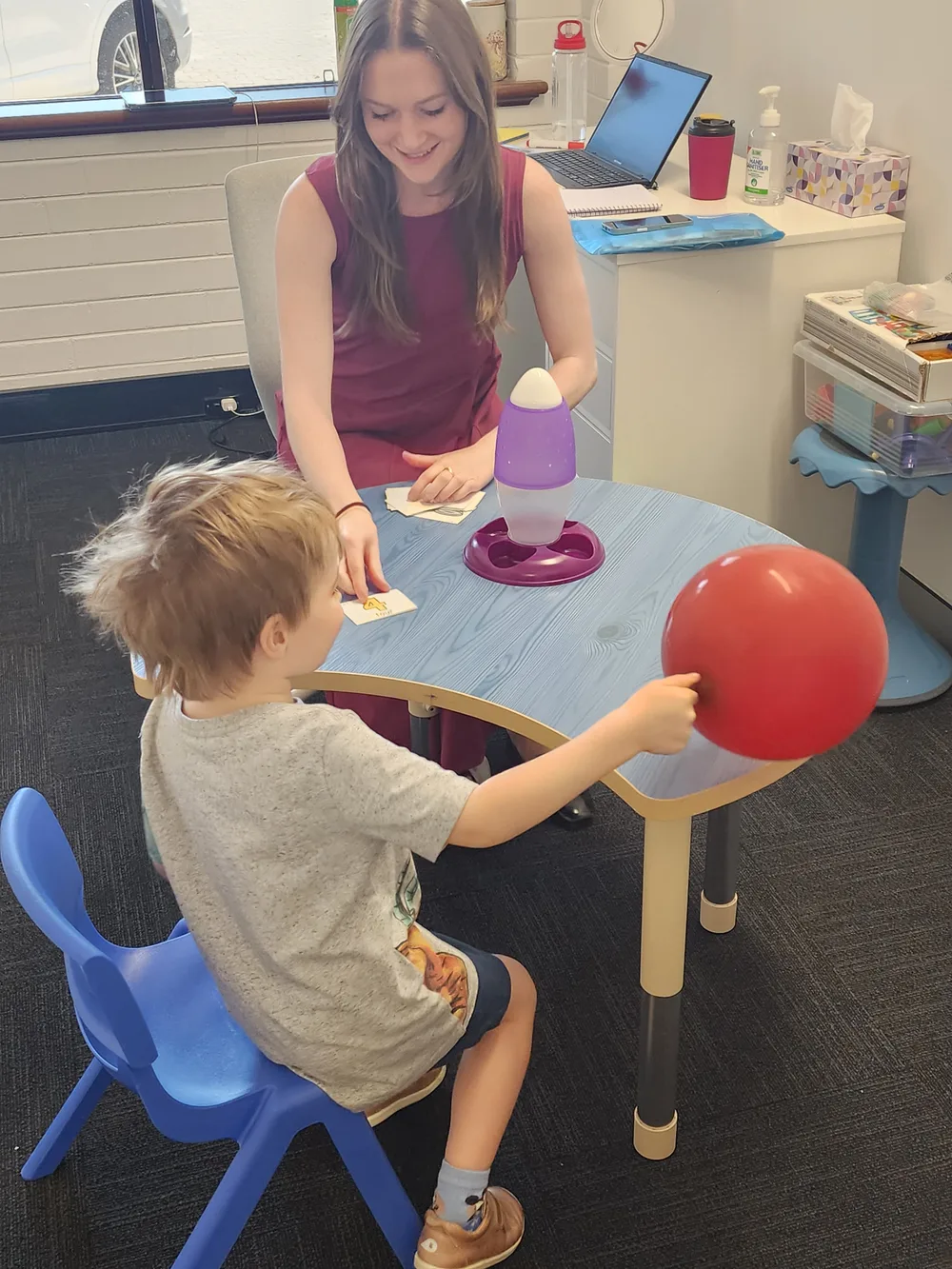
Childhood apraxia of speech
Knowing what to say but finding it hard to get the mouth moving is a possible sign of childhood apraxia of speech.
Who we see
Most children we see for speech sounds are between 3 and 12. We also see children from 2, and young people up to 18. They come with speech sound delays, speech sound disorders, or childhood apraxia of speech.
The first session
We start with a case history. Your child has time to play and settle, then we look at which sounds are hard, what kinds of errors they make, and whether it looks like a delay or a disorder. That shows us where to start. If a sit-down assessment is too much on the day, we assess through play.
Approaches we use
- Phonological approaches: minimal pairs and multiple oppositions
- Articulation: motor-based learning
- Cycles approach, for sound patterns that show up across many words
- Apraxia treatments: DTTC (Dynamic Temporal and Tactile Cueing), ReST (Rapid Syllable Transition Treatment) and PROMPT
Practice at home
Most families do 5 to 10 minutes a day. We pick activities that fit your routine, so the practice turns up in real conversations.
How long it takes
Straightforward articulation can take as little as a school term. More complex speech, including childhood apraxia of speech, usually needs ongoing support. Children respond differently, so we plan from your child's progress rather than a set number of sessions.
Worried about how your child is talking?
Get in touch for a chat about your child and the best way to get started.